
Qeshm Island
UNESCO Global Geopark


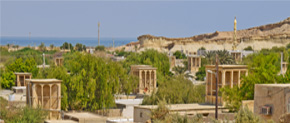


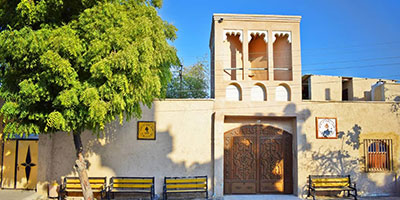


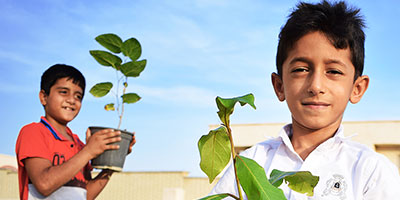


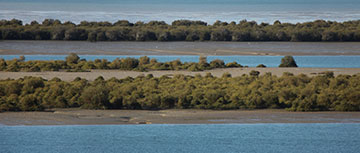
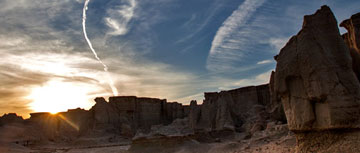

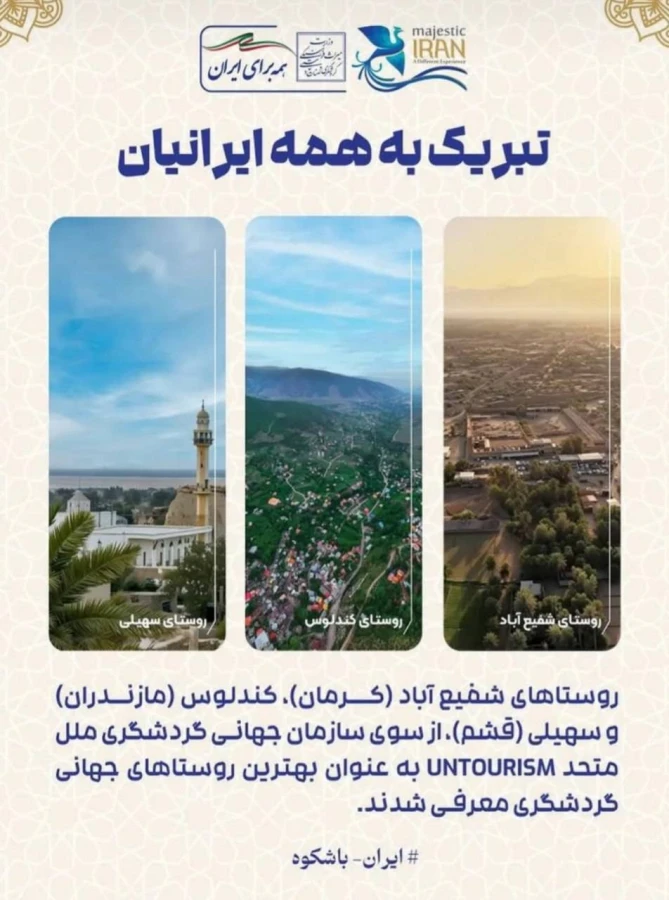
The villages of Soheili (Qeshm Island), Kandolus (Mazandaran), and Shafi’abad (Kerman) have been recognised as “Best Tourism Villages” by UN Tourism.
In a message marking this international recognition, Seyyed Reza Salehi-Amiri described the event as “a turning point in the history of rural tourism in Iran”. He stated that, in an era of civilisational turbulence and rapid global transformation, when the world is increasingly seeking meaning, sustainability and a return to cultural roots, villages are once again at the forefront of global policy attention as sources of authenticity, balance and sustainable ways of living.
He added that the selection of Shafi’abad, Soheili and Kandolus has strengthened Iran’s position among the limited number of countries that have succeeded in having multiple villages included in the UN Tourism Best Tourism Villages list within a single year. This achievement reflects the capacity of local communities, the vitality of national thinking, and the realisation of a development model rooted in culture, identity and local ecosystems.
Referring to the evaluation framework of UN Tourism, the Minister of Cultural Heritage noted that the assessment is based on more than fifty indicators covering areas such as cultural and natural resources, economic and social sustainability, environmental protection, and innovation in tourism. In this context, each of the three selected villages presents a living example of Iran’s cultural diversity and local potential.
Salehi-Amiri outlined the distinctive characteristics of the selected villages. In Kandolus (Mazandaran), the integration of indigenous knowledge and creative development through its herbal medicine branding and local museum represents a model of a knowledge-based rural economy. In Shafi’abad (Kerman), the active role of women in rural tourism, the restoration of qanats and the revival of handicrafts provide an example of the connection between cultural heritage and social empowerment. In Soheili (Qeshm Island), fishermen who have transformed their livelihoods into a platform for environmental protection embody the responsibility of the Iranian people towards nature.
He further emphasised the importance of strategic planning for the future, stating that the Ministry of Cultural Heritage is developing a national roadmap for the international recognition of Iranian villages, while also strengthening infrastructure, providing training for local communities, and producing multilingual content to introduce this living heritage to international audiences, with the aim of enhancing Iran’s visibility within the global tourism community.
Salehi-Amiri described this achievement as the result of “a deep belief in the role of culture in national development”, adding that Iran, with more than 60,000 villages, is a living repository of human civilisation that can, by drawing upon its cultural and social heritage, become a global model for sustainable tourism.
He concluded that the recognition of these three Iranian villages constitutes a cultural statement from Iran to the world; a clear message that genuine development emerges from within culture and cannot be imposed from outside. He expressed confidence that, through sustained commitment to this path, Iran’s name will become ever more firmly established not only within international heritage frameworks, but also in the cultural memory of humanity.
Latest News
-

پرنده نگری در جنگل حرا به مناسبت هفته گردشگری
Published on : Oct 26, 2025 -

آشنایی نوجوانان قشم با میراث طبیعی جزیره؛ تقویت فرهنگ حفاظت از ژئوپارک
Published on : Oct 26, 2025 -

ژئوپارک جهانی قشم از دوربین نگاه شما
Published on : Oct 26, 2025 -
Clean Cave Day
Published on : Oct 26, 2025 -

دیپلماسی ژئوپارک جهانی قشم
Published on : Oct 26, 2025 -

از خلیج فارس تا چین
Published on : Oct 26, 2025 -

قشم در کانون تعاملات بینالمللی ژئوپارکهای آسیا و اقیانوسیه
Published on : Oct 26, 2025 -

سالانه ۲۰۰ هزار نهال حرا؛ تقویت زیستبوم در روستای جهانی سهیلی
Published on : Oct 26, 2025 -

برگزاری آیین «چی چکا حرا سهیلی» با رویکرد گردشگری احیاگر در روستای جهانی سهیلی؛ یادواره زندهیاد ماما حوا
Published on : Oct 26, 2025 -

چی چکای حرا سهیلی
Published on : Oct 26, 2025